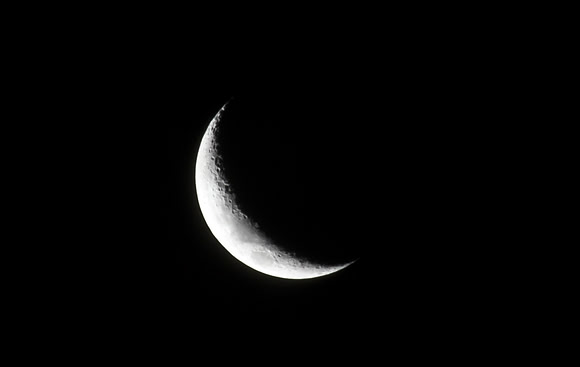
Crescent Moon 1
The Moon is the only natural satellite of the Earth, thought to have formed nearly 4.5 billion years ago, not long after Earth. It is the fifth largest moon in the Solar System and is the largest natural satellite of a planet in the Solar System relative to the size of its planet, having 27% the diameter and 60% the density of Earth, resulting in 1/81 its mass. It's gravitational influence produces the ocean tides and the minute lengthening of the day. br/br/The Moon is in synchronous rotation with Earth, always showing the same face with its near side marked by dark volcanic maria that fill between the bright ancient crustal highlands and the prominent impact craters. It is the brightest object in the sky after the Sun, although its surface is actually dark, with a reflectance just slightly higher than that of worn asphalt. Its prominence in the sky and its regular cycle of phases have, since ancient times, made the Moon an important cultural influence on language, calendars, art and mythology. br/br/The Moon's current orbital distance, about thirty times the diameter of the Earth, causes it to appear almost the same size in the sky as the Sun, allowing it to cover the Sun nearly precisely in total solar eclipses. This matching of apparent visual size is a coincidence.