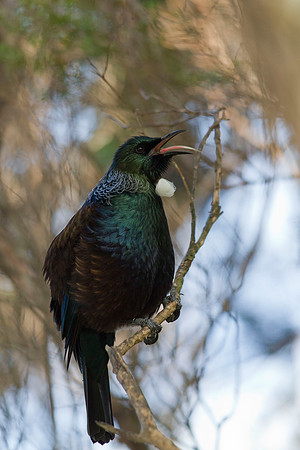
Tui 3
The Tui (Prosthemadera novaeseelandiae) is an endemic passerine bird of New Zealand. It is one of the largest members of the diverse honeyeater family. Common throughout New Zealand in forests, towns and on off-shore islands, these attractive birds can often be heard singing their beautiful melodies, renowned for bellbird-like notes with clicks, cackles, timber-like creaks and groans, and wheezing sounds. Tui have two voiceboxes and this is what enables Tui to perform such a myriad of vocalisations, with some of the huge range of Tui sounds beyond the human register. Watching a Tui sing, one can observe gaps in the sound when the beak is agape and throat tufts throbbing. Nectar is the normal diet but fruit, seeds, pollen and insects are frequently eaten.
The Orokonui Ecosanctuary has become the only place on mainland South Island of New Zealand where native birds, animals and insects can live a life safe from predators. An 8.7km pest-proof fence was completed in 2007 that encompasses 307 hectares of native and introduced forest. Animal pests have been almost entirely eradicated to allow reintroductions of endangered native species such as tuatara, kiwi and takahe. Futhermore it is becoming increasingly common for native birds to find their own way into the ecosanctuary and take up residence.