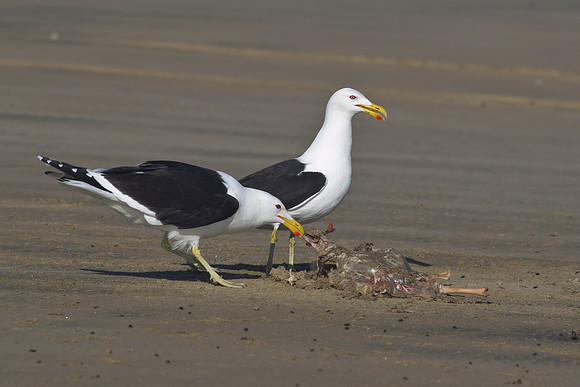
The Southern Black-backed Gull (Larus dominicanus), also known by its Māori name Karoro, is a circumpolar navigator, living in and around the coasts of South America, south–east Australia, New Zealand and the numerous subantartic islands. It lives and breeds in a multitude of places, from rocky ledges to open areas of pasture. They are omnivores like most Larus gulls, scavenging as well as seeking suitable small prey and may be commonly seen picking up shellfish and repeatedly flying up several meters and dropping them onto the rocks below in order to break them open.
It has adapted well to European settlement, from taking advantage of an abundant supply of insects and small animals off pasturelands to scavenging off refuse tips in the urban environment and foraging along the coastal front. On farms they invariably turn up at lambing and at calving time to take advantage of dropped afterbirth and any weak or dead animals.