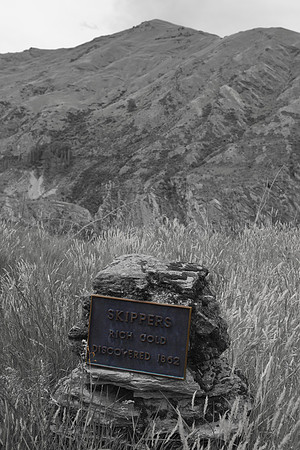
Skippers Point is named after 'Skipper' Malcolm Duncan, who discovered gold in the canyon at Skippers Creek in 1862. Several other gold miners took claims in the area of Skippers Point where they remained working on them until the early 1900s. The remains of their water races, holding dams, sluicings and tailings of the established claims are still obvious today. A huge sluiced basin of the Skippers Sluicing Company's claim, right below Mount Aurum Station's Homestead and Skippers School, is very much visible today, even though it is completely covered by trees.br/br/Skippers Point had an initial population of about 1,000 people but, like Charlestown, stabilised to about 200 around 1864. Today, only the Mount Aurum Station's Homestead and Skippers School as well as the cemetery are visible. br/br/In November 1862, Thomas Arthur and Harry Redfern discovered gold in the area of today's Arthurs Point - about 4 ounces of gold within 3 hours! This was the beginning of one the largest gold rushes in Otago and the miners referred to the Shotover River as the 'richest river in the world'.